
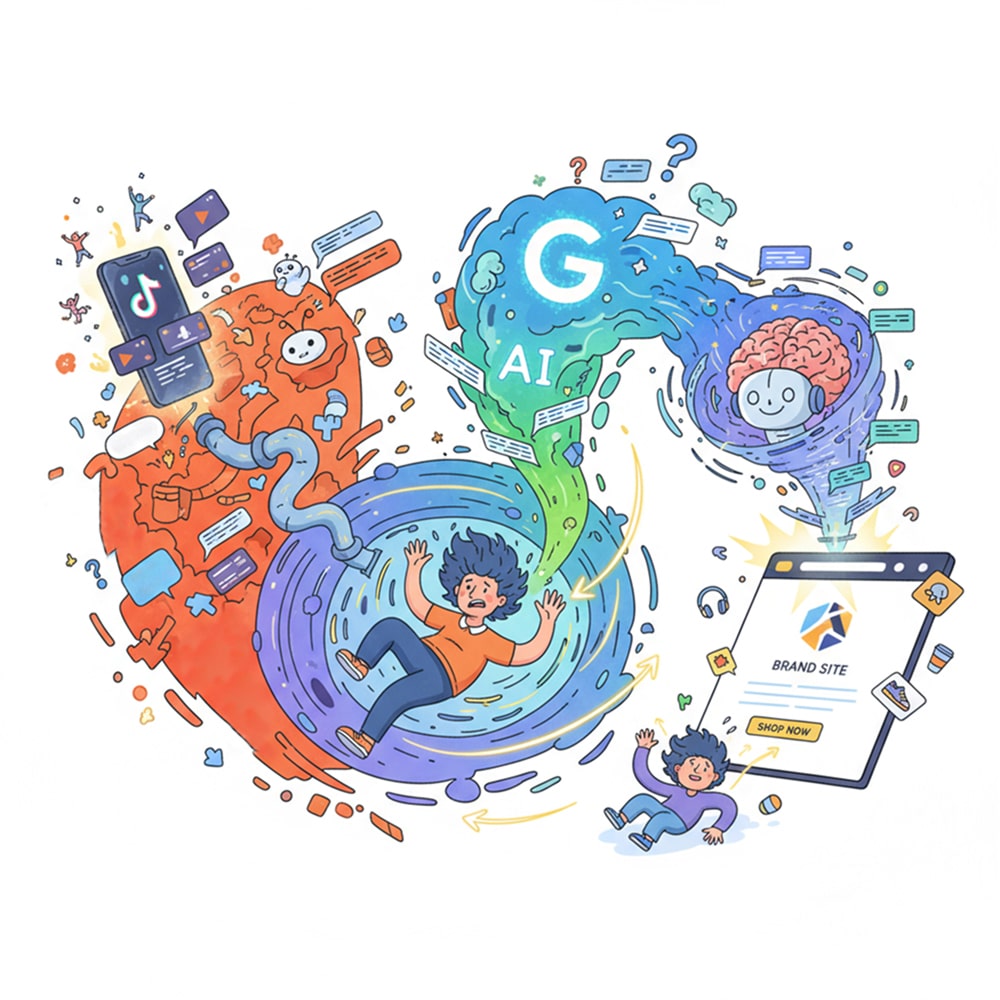
Picture this: Your customer discovers your skincare brand through a TikTok haul video. She screenshots the product name but doesn’t click any links. Later, she searches Google but only reads the AI summary at the top. Still curious, she heads to Reddit asking “Is [brand] actually worth it?” She watches three YouTube reviews before deciding whether to buy.
This messy, multi-platform journey defines discovery in 2025. Your customer’s path rarely begins or ends on your website.
Search has shattered across social platforms, community spaces, and AI assistants. OpenAI launched ChatGPT search at the end of 2024, and it’s already estimated to garner 1% of the search market this year. Semrush’s survey reveals that 67% of businesses now use AI for SEO and content marketing tasks.
Traditional SEO focused on one simple goal: rank #1 on Google. But ranking first means nothing if your audience never reaches the search results page. They make decisions in DMs, Reddit threads, group chats, or based on AI summaries from sources you don’t control.
Modern SEO must become a cross-platform visibility strategy. You need to show up wherever people discover, not just where they search.
How Digital Discovery Actually Works in 2025
Digital fragmentation isn’t just a buzzword, it’s your new reality. Customer attention splits across platforms, formats, and moments that break traditional SEO.
Your modern customer might:
- Watch a product demo on TikTok
- Search for reviews on Reddit
- Check YouTube Shorts for unboxings
- Ask friends in WhatsApp groups
- Google for discount codes
- Get product summaries from ChatGPT
They never visit your homepage.
Discovery Starts Everywhere Except Google
Users don’t always begin with Google. Curiosity sparks on:
- Social platforms like TikTok, Instagram, YouTube Shorts, Pinterest
- Community spaces like Reddit, Discord, niche forums
- AI assistants like Google SGE, ChatGPT, Perplexity, Alexa
By the time someone types a query into Google, they’ve often formed opinions or already converted elsewhere.
Every Platform Speaks a Different Content Language
Each platform demands its own approach:
- TikTok and Reels: Short, vertical, emotional storytelling
- Reddit: Authentic, detailed, skeptical discussions
- Google: Structured, informative, semantically rich content
- Pinterest: Visual, aspirational, lifestyle-focused content
- AI assistants: Credible, concise, well-sourced information
Your Google-optimized blog post won’t work on TikTok. Your Pinterest infographic feels salesy on Reddit. Winning requires being native to each platform.
AI Changes How Search Actually Works
Google SGE, launched in select markets in 2024, partially replaces traditional featured snippets with AI-generated answers. Users now receive answers without clicking. These answers summarize multiple sources without linking to them.
Your content needs to be:
- Crawlable by AI systems and structured for referencing
- Credible enough to earn citations in AI outputs
- Optimised for zero-click environments and voice snippets
Why Traditional SEO Tactics Fall Short
Traditional SEO strategies show their age in a world where discovery is chaotic, platform-native, and AI-mediated. The old playbook fails because it assumes search is linear, predictable, and happens on Google.
Keyword-Only Strategies Miss the Real Journey
Old SEO Rule: Find keywords. Write blog posts. Rank.
This worked when search intent happened mostly on Google. Today:
- Users ask questions in ChatGPT instead of typing queries
- They discover brands through TikTok sounds or Instagram Reels
- They trust Reddit opinions over corporate blogs
Google autocomplete can’t capture this behavior. Someone might never type “best electric toothbrush” but decide to buy one after seeing a creator use it.
What works now:
- Research platform-native queries on TikTok, Reddit, Pinterest
- Repurpose SEO content into multiple formats
- Use social listening tools alongside keyword tools
Google-Only Content Ignores Platform Hopping
Old SEO focused on ranking in blue links. But discovery flows across multiple platforms.
Example journey: User sees product on Instagram → Googles reviews → lands on Reddit → watches YouTube review → asks ChatGPT for pros and cons
Focusing only on Google means missing 80% of this journey.
Better approach:
- Map your audience’s multi-platform discovery paths
- Create content for each stage:
- TikTok: Spark interest
- Reddit: Build trust
- Google: Provide depth
- AI: Offer structured authority
- Focus on content orchestration, not content silos
AI Consumes Content Without Clicking
The most important SEO trends for 2025 center around adapting to the proliferation of AI Overviews and AI answer engines. With Google SGE, Perplexity AI, and ChatGPT’s Browse mode, users get direct answers instead of links.
Your high-ranking blog may now be:
- Summarised without clicks
- Referenced without attribution
- Competing with AI-generated content that doesn’t need backlinks
New requirements:
- Structure content with clear Q&A, headings, and factual blocks
- Use FAQ schema, HowTo markup, and Speakable schema
- Build authoritativeness with real names, bios, credentials, experience
- Become a referenceable source for AI tools
How to Build Visibility Across Fragmented Channels
Visibility in 2025 comes from orchestrating presence across multiple platforms. Attention scatters and search behaviors aren’t linear. Winning brands design content systems, not isolated posts.
Create Platform-Native Content That Ranks Within Ecosystems
SEO now lives inside each platform. Just like Google has algorithms, so do:
- YouTube: Title, description, watch time, tags
- TikTok: Captions, hashtags, watch-through rate, trending audio
- Reddit: Karma, engagement, recency, subreddit authority
- Pinterest: Pin quality, board structure, keyword descriptions
- Instagram: Alt-text, caption structure, content type preferences
Creating content only for Google misses 70%+ of discovery potential.
Action steps:
- Audit which platforms your audience uses most
- Translate blog content into channel-specific formats:
- Long-form blog → TikTok explainer → Instagram carousel → Pinterest graphic → Reddit post
- Respect each channel’s content culture, repackage, don’t just repost
Build Cross-Channel Content Systems
Most brands treat Search Engine Optimization, social, email, and PR as separate departments. But today’s audience moves fluidly between them.
Example system: YouTube tutorial links to support blog → Blog links to downloadable checklist → Checklist appears in TikTok → TikTok embeds in blog update → Reddit user shares checklist → ChatGPT references it in comparisons
Implementation strategy:
- Create intent-based clusters around user questions, not just keywords
- Use internal linking and cross-posting as standard practice
- Track journeys with UTM tagging and engagement heatmaps
Optimize for AI Discovery
AI assistants don’t list links, they summarize, prioritize, and often skip attribution. To earn inclusion in AI summaries:
- Structure content semantically: FAQs, bullet points, subheadings
- Use schema markup: FAQPage, Article, Speakable, HowTo
- Offer clear, sourced insights where others stay vague
- Include author credibility: Names, bios, industry roles, experience
AI models favor data-backed content and niche expertise. Share original research clearly and visibly.
Turn Topics Into Modular Content Engines
Most brands underuse existing content. In fragmented environments, repurposing ensures survival.
Instead of writing 10 posts on 10 topics, create 1 great pillar and:
- Break it into carousels, reels, social posts, Reddit chunks
- Turn FAQs into video scripts
- Pull quotes for AI prompt material
- Package takeaways as newsletter CTAs or audio shorts
Treat each topic like a source kit, not a one-off blog.
Track Visibility Beyond Google Analytics
Traditional SEO reporting tools miss:
- Reddit mentions
- AI-generated citations
- TikTok saves
- Pinterest pin impressions
- LinkedIn carousel views
- Perplexity summaries citing your content without linking
Start using:
- Brand monitoring tools like Mention, Brand24, SparkToro
- Perplexity and ChatGPT Browse to check brand citations
- Platform analytics (TikTok Creator Tools, Pinterest Analytics, Reddit Insights)
- Dark social tracking with UTM links in email shares and DMs
Real Examples: Brands Winning Across Platforms
Some brands master fragmented attention by meeting users exactly where they are, in the right format, voice, and moment. They treat SEO as a visibility system, not a keyword game.
1. Duolingo: Platform-Native Brand Building
Where they appear: TikTok, Instagram Reels, Reddit, YouTube Shorts, App Stores, SEO-optimized landing pages
Duolingo built brand awareness through:
- Viral TikToks using humor, trends, and their owl mascot, earning millions of organic impressions
- Monitoring Reddit threads to understand user concerns, then optimizing FAQ content around those issues
- Repurposing in-app data (learning streaks) into shareable social stats
- Owning high-intent SEO spaces like “[language] learning app” with clean, benefit-focused landing pages
Result: Duolingo ranks well on Google and dominates TikTok search, with users regularly searching “Duolingo owl”, showing how social-first visibility drives search intent.
2. Glossier: Community-Led SEO Through User Content
Where they appear: Instagram, TikTok, YouTube, Reddit, Google Search, Pinterest, Perplexity AI
Glossier built modern SEO around user-generated content and social discovery:
- Instagram tags and TikTok mentions drive massive brand query volume (“glossier skin tint review”) powering SEO rankings
- Product pages target natural search queries (“light coverage foundation,” “hydrating balm”) without SEO jargon
- They track Reddit threads to improve product documentation and write search-aware help content
- Product photography and tone work well on Pinterest and in AI-generated skincare routines
Result: Despite minimal paid search spending, Glossier dominates branded and unbranded skincare searches through smart platform synergy.
3. Dr. Squatch: Video-First SEO and Content Clustering
Where they appear: YouTube, Google, TikTok, Email, Podcasts, influencer partnerships
This men’s hygiene brand grew through video-led storytelling:
- YouTube videos rank for product keywords, offering humor-driven how-tos and routines
- They repurpose videos into TikToks and Reels while embedding them in SEO-optimized blog posts
- Influencers create complementary content (“Best natural soaps for men”) linking back to Dr. Squatch
- Google ranks their videos above product pages, showing multi-format SERP ownership power
Result: They own multiple Google search surfaces, video, image, People Also Ask, top results, while dominating video-based discovery.
4. CeraVe: Scientific Authority Across Formats
Where they appear: YouTube (dermatologist content), TikTok, Google, Reddit, SGE/Perplexity, skincare blogs
CeraVe shifted from medical packaging to science-backed content ecosystems:
- Dermatologist-partnered videos dominate YouTube search for skin issues (“how to treat dry skin,” “retinol tips”)
- Same doctors appear in TikToks and Reels that educate rather than sell, building trust
- They answer Reddit-style questions directly in on-site SEO content with FAQ schema
- Frequent citations in AI-generated skincare summaries due to their mix of expertise and educational structure
Result: They rank in Google and appear in AI assistants and social-led discovery paths, fusing trust, science, and structure.
Content as a Referenced Resource, Not Just Ranked Pages
In 2025’s fragmented search environment, visibility isn’t about being found, it’s about being referenced and relied upon.
Traditional SEO aimed to get pages ranked. Today’s AI-assisted, zero-click, multi-platform environment means your content might:
- Be read but never clicked
- Get cited by AI assistants without attribution
- Be shared in Reddit comments or WhatsApp groups, separated from your domain
- Be summarized in SGE or Perplexity without your brand name appearing
Being useful now matters more than being top-ranked.
AI Changes Discovery Patterns
Whether it’s Google’s SGE, Perplexity, or ChatGPT with Browse, AI absorbs your content and redistributes it as synthesized insights. Users ask one AI assistant instead of visiting five blogs.
Content that gets used in AI-generated outputs has these traits:
- Clear, structured formatting
- Specific, expert-level insights
- Attributable data or statistics
- Consistent topical authority over time
Without these elements, you may never get referenced, even with high domain authority.
Make your content AI-citable:
- Use clear Q&A formats, bulleted takeaways, definitions, examples
- Include original analysis or data-backed opinions, not generic content
- Use internal linking to connect concepts clearly for crawlers
Authority Through Original Experience
Everyone has access to generative AI now. Authority comes from originality and experience, not repeating common knowledge.
To earn referencing power:
- Feature named authors with real-world experience
- Include case studies, quotes, or perspectives from your team or partners
- Show your content’s value outside SEO: use it in presentations, forums, press coverage, LinkedIn posts
This makes your content shareable on human networks, crawlable for AI systems and credible in zero-click environments, Treat every article like a source, not just a ranking asset.
Brand as Trusted Resource
People won’t trust your product if they don’t trust your content.
Modern content should:
- Answer questions neutrally before trying to convert
- Offer educational depth without click-baiting
- Position your brand as an ecosystem resource, not just for customers
There’s a difference between: “A brand that sells sunscreen” and “The authority on protecting skin across climates, routines, and skin types”
The Takeaway
SEO rules changed because search itself evolved beyond the engine. Discovery isn’t linear, it’s chaotic. Products get discovered on TikTok, questioned on Reddit, confirmed by Google, and bought after ChatGPT comparisons, all within minutes.
Brands optimizing for only one part of this journey remain invisible everywhere else.
Winners in 2025:
- Engineer discoverability across ecosystems
- Create content that’s referenceable, repurposable, and platform-native
- Understand SEO as earned trust signals across multiple surfaces
- Focus on visibility, credibility, and cross-channel presence as new success metrics
Your content doesn’t just need discovery, it needs recognition, citation, sharing, and trust, even without clicks.
This isn’t traditional SEO. This is Search Experience Engineering for a platform-hopping world.
Ready to make your brand visible where it actually counts? Sphere Media helps businesses navigate this new discovery reality. We create content ecosystems that work across AI tools, social platforms, and search engines through our integrated approach combining Social Media Marketing, Website Design, Mobile App development, Creative Design, and Search Engine Optimization services.
Your audience isn’t just on Google, your strategy shouldn’t be either. Let’s build visibility that reaches your customers wherever they discover, research, and decide.