
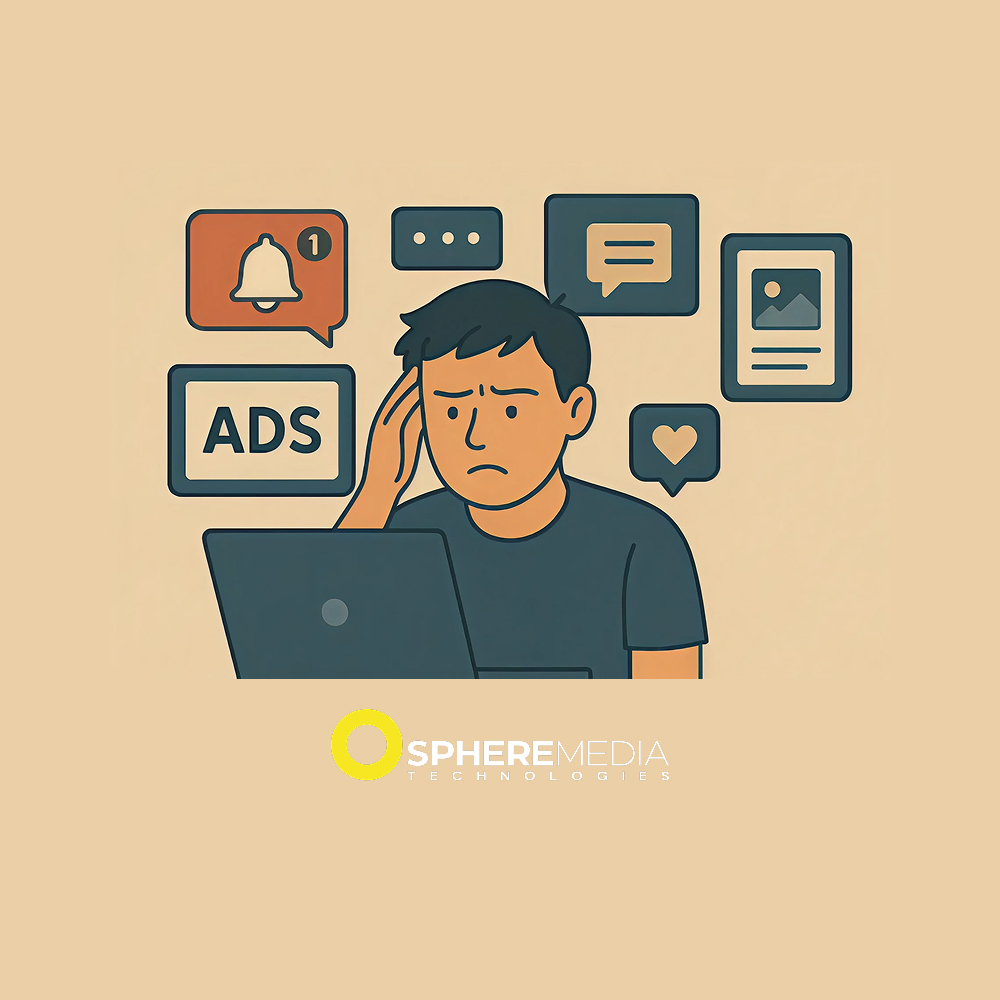
The Modern Advertising Puzzle
Brands are spending more than ever on advertising. Global ad spending is forecasted to reach $1.17 trillion in 2025, with digital advertising expected to account for 73.2% of that revenue. Companies pour money into social media, streaming platforms, connected TV, search campaigns, and display networks. Yet here’s the catch: bigger budgets don’t always deliver bigger results.
You’ve probably noticed this yourself. Your team increases spending, impressions go up, but engagement stays flat. Sales don’t follow the upward curve you expected. Brand loyalty remains elusive. What’s happening?
A modest 5% increase in attention can lead to a 40% boost in ad awareness, according to Dentsu’s research. This tells us something important: the problem isn’t about spending enough money. Consumers face an avalanche of content every single day—short videos, scrolling feeds, push notifications, and countless ads competing for seconds of their focus.
Human attention spans have declined from 12 seconds in 2000 to 8 seconds in recent years. Think about what that means for your campaigns. You’re not just competing with other brands anymore. You’re competing with everything demanding attention in that moment.
This article breaks down why massive budgets fail in today’s environment. You’ll learn what actually drives results when everyone’s distracted, and discover practical ways to make your marketing dollars work harder without simply spending more.
Attention Has Become the Scarcest Resource
Remember when brands could rely on prime-time TV slots or full-page magazine ads? Those days are gone. Today’s consumers navigate hundreds—sometimes thousands—of stimuli daily. Every scroll competes with multiple ads, notifications, and content streams fighting for the same limited focus.
Channels have multiplied beyond recognition. Your audience splits attention between social media platforms, streaming services, podcasts, connected TV, TikTok, Instagram Reels, and AI-generated content. People don’t passively consume anymore. They curate what deserves their attention. They skip ads. They install blockers. They control what reaches them.
Multi-screen usage makes this worse. Someone watches TV while scrolling on their phone and checking their tablet. Their attention fragments across three devices simultaneously. TikTok saw a 40% year-over-year decrease in engagement rates in 2024, even as the platform continued growing. This shows how saturated the space has become.
Short-form content encourages rapid scrolling. Your ad gets seconds—not minutes—to register. Ad fatigue sets in quickly. People encounter repetitive or irrelevant campaigns and tune out. Engagement drops. ROI shrinks, even as spending climbs.
Budget size doesn’t define success anymore. Your ability to earn and keep attention does. Brands that miss this shift waste money on channels where audiences exist but don’t truly engage. You need precision, not just presence.
Why Bigger Budgets Often Deliver Smaller Results
Throwing more money at advertising seems logical. More budget equals more visibility, right? Not in today’s attention-scarce world. More money rarely guarantees better outcomes.
Oversaturation kills campaigns. Additional budget creates more impressions, but impressions don’t automatically become engagement. Consumers have mastered the art of tuning out repetitive, irrelevant, or intrusive messages. High-spending campaigns underperform constantly.
Media consumption has fragmented. People jump between smartphones, tablets, connected TVs, and desktops. They scroll rapidly through feeds. They skip YouTube ads. They ignore display banners. They engage selectively with content that resonates. Increasing ad frequency can’t overcome fragmented attention spans.
Targeting matters more than volume. Throwing budget at campaigns doesn’t fix misalignment between content and audience. High spend on poorly targeted or generic messaging floods the market with impressions that don’t drive conversions, brand recall, or loyalty. Massive budgets fail when they don’t reach the right people at the right time.
More than 60% of advertisers expect budget declines of 6-10% in 2025, with economic uncertainty forcing smarter allocation. Brands are learning that strategy beats spending.
Real-world data confirms this. A global electronics brand invested tens of millions in a multi-channel product launch. TV, social media, display, search—they dominated impression counts. Post-campaign analysis revealed low engagement, minimal website interaction, and weak conversions. Consumers reported ad fatigue and skipped repetitive messaging. High budgets couldn’t guarantee meaningful impact because the messaging lacked personalization and context.
Compare that to a mid-sized fashion e-commerce brand. With a modest budget, they focused on hyper-targeted social media ads using AI-driven insights. They tested creative iteratively, optimizing visuals and copy based on engagement data. Results? Higher click-through rates, stronger conversions, and measurable uplift in repeat purchases—with less than half the spending.
The lesson is clear: in a world where consumer attention limits everything, throwing money at ads without strategy, relevance, and creativity doesn’t work. You need to shift from volume to quality engagement.
Quality Beats Quantity Every Time
Marketers are waking up to a reality: sheer impression volume doesn’t drive results anymore. Quality of engagement matters far more than quantity. Tracking attention minutes, click-through rates, dwell time, and interaction depth provides richer insights than raw impression counts ever could.
Brands optimizing for meaningful engagement instead of reach see higher ROI and stronger brand equity. Why? Because they focus on what actually matters to their audience.
Personalization Creates Connection
Consumers drown in content across multiple channels. Your ads must feel tailored to their needs, interests, and context. Data-driven strategies—using first-party insights, behavioral signals, and AI-assisted targeting—let you deliver messaging that aligns with individuals, not generic masses.
Personalized campaigns capture attention more effectively. They build trust and brand affinity. A challenger FMCG brand adopted short-form video content on TikTok and Instagram Reels. Instead of pushing impressions, they used trending formats, authentic storytelling, and community-driven engagement. Videos went viral despite a small budget. Brand awareness, engagement, and sales exceeded projections. Creative resonance and contextual relevance amplified impact without requiring massive spend.
Creative Quality Cuts Through Noise
High-quality visuals, compelling storytelling, and thoughtful messaging are critical now. Ads that are visually striking, emotionally resonant, or contextually relevant outperform generic, high-frequency campaigns—even when the latter have much larger budgets.
Placement matters too. Ads appearing alongside relevant content or in environments where users are receptive significantly amplify performance. The global native advertising market is projected to reach $400 billion by 2025—a 372% increase from 2020. This growth reflects preference for non-intrusive, value-driven campaigns designed to capture attention naturally.
Measurement Drives Success
Recent research underscores this shift. Campaigns optimizing for attention quality and context, even with smaller budgets, delivered up to 40% higher brand recall and conversion rates than campaigns focusing solely on impressions. Modern advertising success means earning attention, not buying it.
Brands embracing this shift—prioritizing engagement, personalization, and creative excellence—position themselves to thrive in today’s saturated market. You can’t force attention anymore. You have to earn it.
Smart Strategies That Maximize Impact
Target with Precision
Stop throwing money at broad campaigns. Focus on precision targeting instead. Use first-party data, customer insights, and micro-segmentation to reach the right audience at the right moment.
Purchase history, engagement patterns, and behavioral signals help tailor messaging to smaller, highly relevant segments. This reduces wasted impressions and boosts ROI. Think of it this way: would you rather speak to 100,000 people who might be interested, or 10,000 people who definitely are?
Optimize Creative for Attention
Creative quality determines success more than media volume in the attention economy. Focus on storytelling that resonates, interactivity that encourages engagement, and formats that capture attention quickly.
Short-form videos, dynamic visuals, and contextually relevant messaging work particularly well across social platforms. Creative testing and iteration ensure content remains compelling and aligned with audience preferences. Don’t settle for “good enough” when you can test what truly works.
Embrace Experimentation
Smarter campaigns rely on continuous testing and data-driven optimization. A/B testing creative, messaging, and formats enables you to learn quickly what works and what doesn’t.
AI-powered analytics provide insights into engagement patterns, optimal timing, and channel performance. Iterative campaigns allow real-time adjustments, minimizing spend on ineffective tactics while amplifying high-performing elements. Brands maintaining awareness spending for at least ten months see 27% stronger return on ad spend compared to those who stop after three months.
Diversify Your Channels
Maximizing impact doesn’t mean relying on one medium. Effective strategies integrate paid, owned, and earned media, ensuring consistent messaging while reaching audiences where they naturally spend time.
Paid social ads drive awareness. Owned email campaigns nurture leads. Earned content or influencer collaborations amplify credibility. This diversification reduces dependence on any single channel and makes campaigns more resilient to market fluctuations.
Here’s what works:
- Precision over scale—the right audience beats mass reach
- Creativity must earn attention, not just occupy space
- Data and experimentation refine campaigns continuously
- Integrated channel strategies ensure broader impact without proportional budget increases
You can achieve meaningful engagement, stronger brand resonance, and higher ROI without escalating budgets. The trap of “spend more to get more” doesn’t work anymore.
Rethink How You Invest in Advertising
The era of pouring ever-increasing budgets into advertising and expecting guaranteed results has ended. Success today comes from understanding audiences, delivering relevant messaging, and creating memorable, high-quality creative.
Overspending without strategy risks wasted impressions, low engagement, and diminishing returns. Brands prioritizing attention, context, and creativity over sheer volume cut through the noise and achieve measurable impact.
What should you do right now? Audit your current ad spend critically. Identify campaigns driving real engagement versus those simply inflating reach numbers. Focus resources on high-impact initiatives—precision targeting, short-form interactive creative, and integrated media strategies. This lets you maximize ROI without escalating budgets unnecessarily.
Continuous measurement and optimization are essential. Track meaningful metrics like dwell time, click-through rates, and conversions rather than relying solely on impressions or last-click attribution. What gets measured gets improved.
Work with Strategic Partners
Navigating this environment is complex. Agencies like Sphere Media combine strategic insight, creative expertise, and data-driven optimization to help brands deploy budgets more efficiently. Strategic partners help you navigate the fragmented attention economy and implement campaigns that resonate in a distracted world.
Collaboration ensures every dollar spent contributes to lasting engagement, brand affinity, and tangible business results—not just visibility. You need partners who understand that attention is currency now, and who know how to earn it for your brand.
The mindset shift is simple but powerful: move from “more spend equals more success” to smart, attentive, and creative investment. Understanding your audience, creating compelling experiences, and measuring meaningful outcomes define the future of effective advertising.
Ready to make your marketing budget work harder? Stop chasing impressions. Start earning attention.