
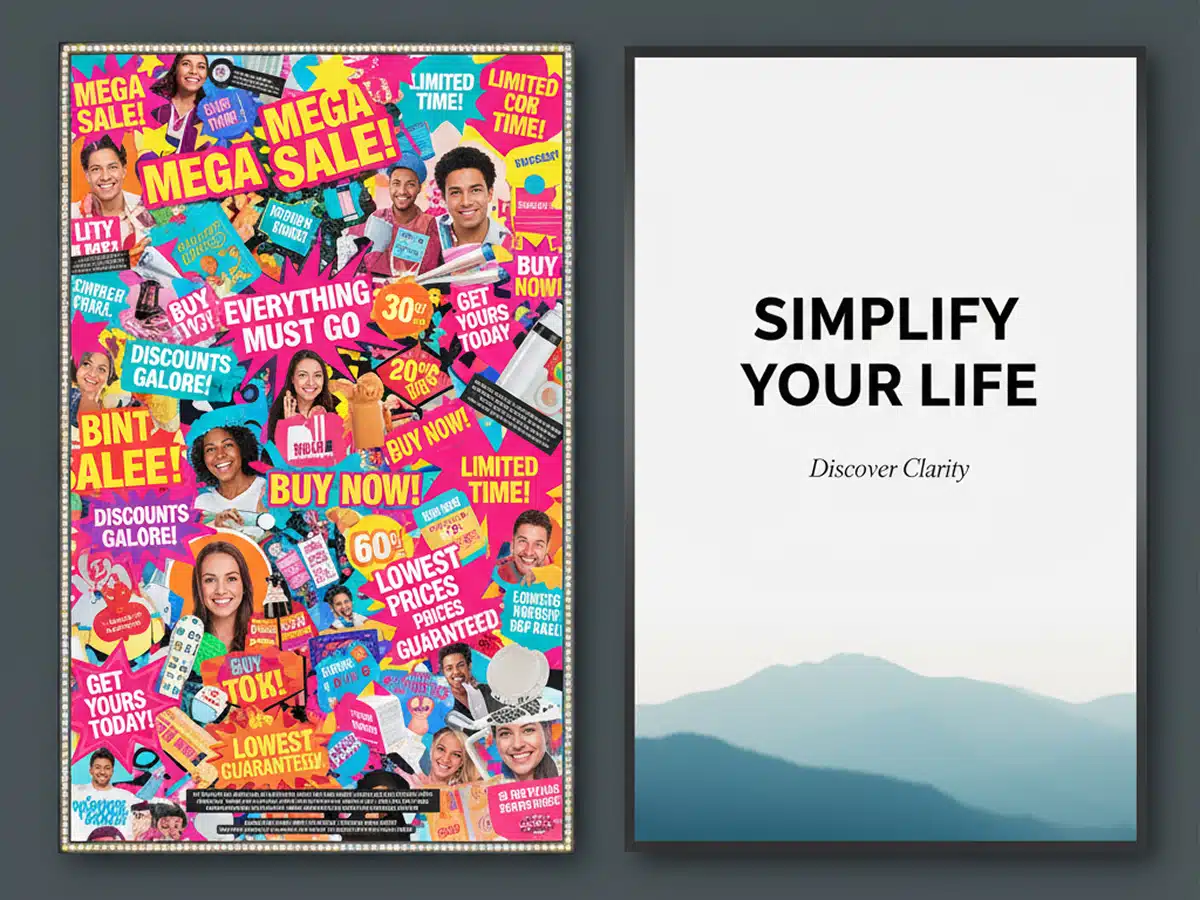
Quiet Ads: Why Minimalist Messaging Gets Maximum Reach
Consumers face information overload every single day. The messages that stick are often the quietest ones. Digital fatigue pushes brands toward minimalist advertising. Stripped-down visuals, concise copy, and subtle calls-to-action create remarkable results.
Your audience craves simplicity. They want clarity over complexity. This shift changes everything about how you approach marketing campaigns.
How Your Brain Responds to Simple Messages
Ad fatigue hits your customers hard. They become numb to repetitive and intrusive advertising. Minimalist ads work differently. They leverage your brain’s natural preference for simplicity and clarity.
These ads reduce cognitive load. Your core message shines through. Better recall and engagement follow naturally.
Think about your last scroll through social media. Which posts made you stop? Likely the clean, simple ones that communicated one clear idea.
Real Brands Winning with Minimalist Campaigns
- British Airways Strips Down Their Logo
British Airways made a bold choice. They displayed less than 25% of their logo in outdoor advertisements. No taglines. No elaborate visuals. Just stark simplicity.
This approach stood out among cluttered advertising spaces. It conveyed confidence and elegance. Sometimes showing less says more.
- The Ordinary Takes Text to the Streets
The skincare brand placed plain text on white backgrounds. Their billboards avoided images and colors completely. They relied solely on words to communicate their message.
This created striking contrast in visually saturated environments. People noticed because it broke the pattern.
- McDonald’s Lights Up Recognition
McDonald’s showcased their golden arches using only spotlights on a billboard. They added one phrase: “Open at night.” This minimalist execution relied on brand recognition and clever lighting.
No overt messaging was needed. The audience filled in the gaps.
- Justin Bieber Masters Silent Hype
Most celebrities flood the internet with product drops and launch explosions. Justin Bieber flips this script completely.
His upcoming apparel brand gains massive traction without traditional ads. Here’s his strategy:
- Sparse Instagram Stories: He shows textures, fabric folds, or blurry hoodie outlines without captions
- Muted Color Palette: All visuals use bone, graphite, and off-white tones
- Unbranded Street Appearances: He wears the clothes publicly without announcing they belong to his label
- Simple Website Launch: A countdown clock and single phrase: “Clarity Is a Choice”
This silent hype strategy creates curiosity, exclusivity, and emotion. No “Buy Now” buttons needed. Quiet ads don’t whisper – they echo.
Why Minimalism Works Right Now
Your customers’ brains process simple designs faster. This makes them more memorable. Consider these key factors:
- Cognitive Ease: Simple designs register quickly in busy minds.
- Contrast Effect: Minimalism stands out in complex advertising seas.
- Authenticity: Stripped-down messaging feels genuine, not manipulative.
- Adaptability: Minimalist designs work across all platforms and devices.
Building Your Own Minimalist Campaigns
You can implement minimalism without losing effectiveness. Start with these practical steps:
- Focus on One Message: Determine the single most important takeaway for your audience. Everything else is noise.
- Embrace White Space: Allow your design to breathe. Guide your viewer’s focus intentionally.
- Limit Color Palette: Use colors strategically to evoke emotions and highlight key elements.
- Simplify Copy: Use concise language that conveys your message effectively.
The Science Behind Simple Messaging
Visual noise blocks attention in our content-flooded world. Neuroscience shows us something important. Your brain favors clarity and simplicity naturally.
Clean visuals and minimal text process faster than overloaded layouts. They create greater emotional retention too. Minimalist messaging becomes a performance tool, not just a design choice.
Cognitive Fluency Builds Brand Trust
Minimalist ads require less mental effort from users. This creates cognitive fluency – a sense of ease and reliability. Easier processing leads to more positive judgments.
Brands like Apple, Aesop, and Glossier feel trustworthy before you even click. Their clean design creates this immediate confidence.
Beauty and fashion brands especially benefit from this effect. Clean, whitespace-heavy visuals with one core message make products feel premium. Fintech and SaaS companies reduce decision anxiety by eliminating distractions.
Attention Sharpens Instead of Shrinking
Modern attention spans aren’t shrinking – they’re getting sharper. Users don’t want to scan everything. They want to grasp quickly.
Minimalist visuals use negative space strategically. They guide eyes toward single emotional or functional points. Eye-tracking studies prove this works.
Simpler visuals lead to faster CTA engagement. Brand recall improves within the first 3 seconds of exposure.
Simplicity Creates Emotional Connection
Information overload makes brains defend themselves by ignoring complexity. Minimalist messaging feels like relief when done right. It becomes the cognitive equivalent of a deep breath.
This simplicity creates emotional stickiness. You don’t just see the brand – you feel it.
Converting with Smart Minimalism
Minimalism doesn’t mean removing everything. You remove everything that isn’t essential. The key lies in knowing what to strip back and what to amplify strategically.
Minimalism Equals Intentional Hierarchy
Many brands confuse clean design with under-communicating. High-conversion environments need clarity, not mystery. Smart minimalism focuses eyes using intentional hierarchy.
Use bold CTAs, clear benefits, and emotionally resonant images. Think of whitespace as a functional guide, not emptiness.
Eye-tracking heatmaps show important results. Users gravitate toward core messaging faster in whitespace-heavy designs. Their gaze lingers longer on trust-building elements when these elements are clearly isolated.
Where to Strip Down Your Content
Copy: Cut marketing filler and strip headlines to essential emotional messages. “Faster Payments, Less Friction” works better than lengthy explanations.
- Visuals: Avoid decorative images. Use one purposeful hero visual that captures intent or identity.
- Navigation: Reduce menu options and pop-ups that distract from main actions.
Where to Build Trust Elements
- Trust Badges: Place them strategically near CTAs, especially in industries where skepticism runs high.
- Pricing Clarity: Don’t hide costs. Transparent, modular pricing sections with ample spacing build more conversions than cluttered comparison charts.
- Social Proof: Integrate minimal but powerful testimonials. One sentence from a known name carries more weight than walls of anonymous reviews.
Testing Your Quiet Advertising Strategy
Going minimalist doesn’t mean going blind. Minimalist messaging needs more testing, not less. Subtlety leaves less room for error.
Good news: quiet ads can generate loud data when done right.
Email Subject Line Experiments
Email provides a great low-risk playground for testing minimal messaging. Try split-testing approaches:
Loud Version: “FLASH SALE: 40% OFF Ends Tonight ⏳” Quiet Version: “It’s Ending.”
Multiple industries show Subject B often achieves higher open rates among fatigue-prone users. It forces a pause, a second glance, or a curiosity click.
Above-the-Fold Testing
Remove clutter from your hero section. Test versions with navigation, text overlays, and subtext against versions featuring only:
- One bold headline
- One visual or animation
- One high-contrast CTA
Watch these metrics change:
- Time to interaction
- Scroll depth
- CTA engagement
Tools like Hotjar and VWO visualize how whitespace-heavy versions cause less rage clicking and more linear attention toward CTAs.
Performance Benchmarks for Quiet Campaigns
Don’t just test for clicks – test for reactions over time. Quiet ads tend to drive:
- Longer dwell time on landing pages
- Higher engagement with fewer distractions
- Slower burn, higher recall – perfect for brand perception campaigns
Mobile-First Minimalism Strategy
Minimalism isn’t just a design preference on mobile – it’s a survival tactic. Over 60% of digital traffic comes from smartphones. Your message has milliseconds to land.
Stripped-back layouts, brief copy, and frictionless navigation become strategic imperatives on small screens.
Mobile Editing Demands Simplicity
Mobile doesn’t tolerate fluff. Bloated headlines get cut off. Oversized hero images load too slowly. Busy layouts make users pinch, zoom, scroll, and bounce.
Minimalist design thrives here:
- Clear visual hierarchy (one focal point per screen maximum)
- Short-form copy (4-6 words per line maximum)
- Essential-only buttons (one CTA per view)
Each choice respects user context – thumb navigation, short attention spans, and real-world distractions.
Speed Benefits of Simple Design
Minimalist interfaces reduce image weight, Javascript bloat, and font overload. This creates faster load times. Google’s Core Web Vitals reward speed – users demand it.
Bounce probability increases by 32% as page load time goes from 1 to 3 seconds. Minimalism trims fat without trimming function.
Minimalist layouts also reduce Cumulative Layout Shift (CLS). This proves critical for mobile SEO and user experience. No more surprise jumps when buttons shift mid-scroll.
B2B Applications of Minimalist Marketing
Many B2B companies avoid minimalist approaches. They fear stripped-down visuals might seem too simple or lack professional authority. Leading B2B brands like Stripe, Notion, and Figma prove this wrong.
Minimalist storytelling provides powerful clarity, trust, and market positioning – especially in complex industries.
Clarity Through Focused Communication
B2B products often involve technical specifications and layered benefits that overwhelm potential buyers. Minimalism cuts through complexity by spotlighting core value propositions.
Stripe employs clean layouts, ample whitespace, and concise copy to communicate payment solutions quickly. This simplicity helps users understand benefits immediately. It reduces cognitive friction during research phases.
Building Trust with Transparent Messaging
B2B relationships require trust above everything else. Minimalism enhances trust by removing visual clutter and emphasizing straightforwardness.
Figma’s design platform uses minimalist principles to highlight customer success stories, pricing transparency, and clear calls-to-action. The absence of flashy design signals confidence. Product merits shine through clearly.
Positioning Through Intentional Storytelling
Notion’s minimalist approach shows how pared-back messaging can still engage deeply. Their Website Design uses sparse color palettes and focused copy to emphasize customization, collaboration, and productivity.
Minimalism doesn’t sacrifice personality here. It helps brand narrative come across more coherently and memorably. Notion positions itself as both approachable and professional.
SEO Strategy for Quiet Advertising
Minimalism thrives on simplicity, but simplicity shouldn’t hurt discoverability. AI-driven search landscapes use nuanced signals for ranking and relevance.
Quiet ads risk reduced keyword density or fewer textual cues that traditional Search Engine Optimization relies on. Smart marketers balance minimalist design with strong SEO through deliberate strategies.
Structured Data Powers Silent SEO
Visible content might be sparse, but behind-the-scenes markup provides search engines rich context. Structured data (schema markup) labels key elements like product details, reviews, pricing, or event information.
This makes minimalist pages more “readable” to machines without cluttering user experience. Hidden data layers help quiet ads surface in rich snippets and voice search results.
Optimised Alt-Text Gives Visuals Voice
Minimalist ads often rely on single, powerful images or icons. Properly crafted alt-text improves accessibility and reinforces keyword relevance.
Generic descriptions don’t work. Alt attributes should reflect brand core messages and target terms thoughtfully. Even quiet ads with minimal copy contribute valuable signals for image search and AI-powered discovery tools.
Meta Tags Balance Punch with Precision
Meta titles and descriptions remain critical for balancing minimalist messaging with search intent. Craft these elements with clear, targeted keywords to guide AI-driven platforms. Minimalism favors short, punchy copy and within meta tags, you have room to elaborate strategically. Offer fuller pictures to search engines without overwhelming audiences.
The Takeaway
Digital noise creates opportunity for quiet messages. Minimalist advertising cuts through saturation by embracing simplicity, clarity, and intentionality. B2C to B2B, mobile-first to complex SaaS platforms – minimalist storytelling builds trust and drives engagement.
Minimalism requires precision, balance, and testing. It’s strategic choice, not emptiness. Pair minimalist design with thoughtful SEO practices. Your message stays emotionally impactful and discoverable in AI-driven search.
Strip back copy, limit visuals, or pare down navigation with one goal: create meaningful connections that resonate quickly and linger long after first glance.
Quiet ads don’t whisper – they echo. Sometimes the most powerful message lives in spaces between words.
Sphere Media Technologies, specializes in Social Media Marketing and Creative Design that cuts through digital clutter. We help brands craft clear, compelling campaigns using minimalistic principles that connect with audiences on a deeper level. Our Website Design and Mobile App Development services embrace intentional simplicity that drives results.
Ready to harness quiet advertising power for your brand? Connect with us today to explore how we can elevate your brand to new global heights.